|
Go To Page:
[
1
]
[
2
]
[
4
]
[
5 ] [ 6 ]
[
7 ] |
|
Page 3
|
Cost
|
Item Description
|
Click Picture
for Larger Image
|
|

|
$30.00 |
PN304b
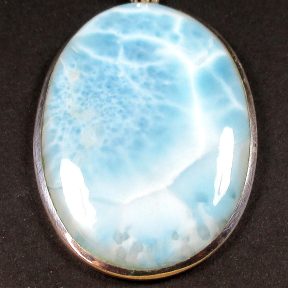
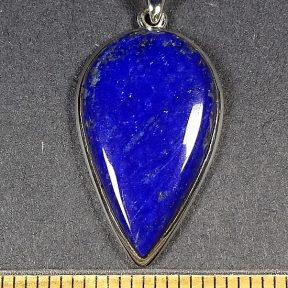
This is a very pretty sterling Silver pendant with a 24 mm x 16 mm Blue
Lapis stone. This pendant measures over 1 3/4" from the top of the bail
to the bottom of the setting. The bail size is 1/4".
Lapis is a stone with a long tradition of being considered a gem.
It is usually deep blue in color and is opaque. It is a rock and not
a mineral as it is made up from various other minerals. The main component
is Lazurite which is a Feldspar Silicate. Lapis may also contain Calcite,
Sodalite and Pyrite. It is found worldwide.
|
Lapis
|
|

|
$38.00 |
PN300c
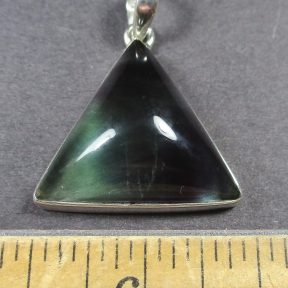
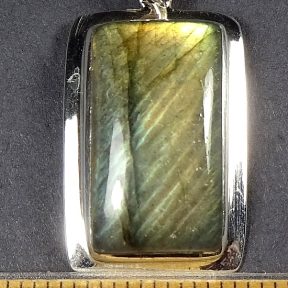
This is a very pretty sterling Silver pendant with a beautiful Labradorite
cabochon. The stone measures 8 mm x 34 mm and has a nice sparkly iridescent
appearance. This pendant measures 2" from the top to the bottom of the setting.
The bail size is 1/4".
Labradorite is a Feldspar mineral that occurs in large Crystal masses in
anorthosite and shows an iridescence or "play of colors." Gemstone varieties
of Labradorite exhibiting a high degree of iridescence are Spectrolite, Moonstone
and Sunstone. High quality samples with good iridescent qualities are
desired for jewelry.
|
Labradorite
|
|

|
$25.00 |
PN305c
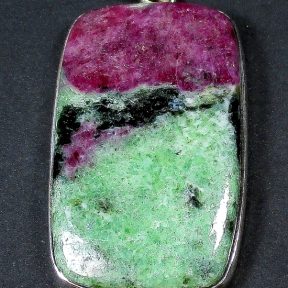
This is a very pretty sterling Silver pendant with a 23
mm x 25 mm Green Turquoise cabochon. This pendant measures nearly 2"
from the top of the bail to the bottom of the setting. The bail size
is 1/4". Turquoise is an opaque, blue to green mineral
that is a mixture of Copper and Aluminum Sulfates. It is rare and valuable
in finer grades and has been prized as a gem and ornamental stone for thousands
of years. It has been devalued by the introduction of imitations and
synthetics that are often hard to detect even by experts. Turquoise
is most frequently used in jewelry manufacturing and is often combined with
other minerals and gemstones to enhance its beauty. It was a favorite
among Egyptians and Native American cultures.
|

Turquoise
|
|

|
$24.00 |
PN303b
Here is a very nice sterling Silver pendant with a very pretty
Labradorite cabochon. It measures 1 3/4" from the top of the bail to
the bottom of the setting. The Labradorite cabochon measures 18 mm x
27 mm. The bail measures 1/4". A very beautiful, stunning pendant.
Labradorite is a Feldspar mineral that occurs in large Crystal masses in anorthosite
and shows an iridescence or "play of colors." Gemstone varieties of
Labradorite exhibiting a high degree of iridescence are Spectrolite, Moonstone
and Sunstone. High quality samples with good iridescent qualities are
desired for jewelry.
|

Labradorite
|
|

|
$18.00 |
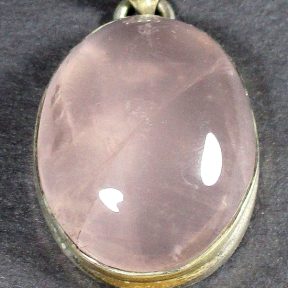
PEN35b
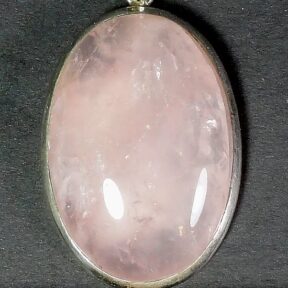
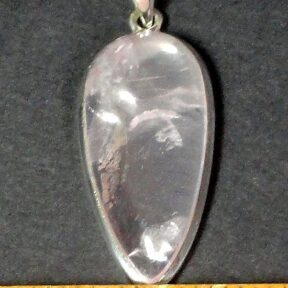
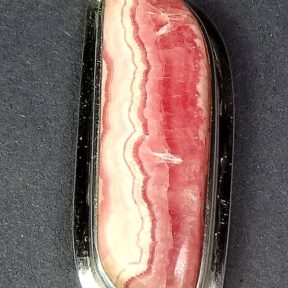
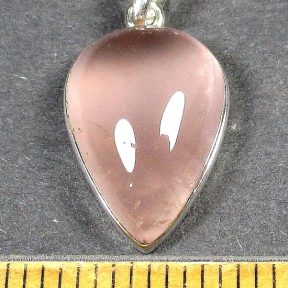
This is a very pretty sterling silver pendant with a 20 mm x 27 mm Rose
Quartz stone. This pendant measures 1 1/2" from the top of the bail
to the bottom of the setting. The bail size is 1/4".
Rose Quartz is a type of Quartz which exhibits a pale pink to rose red
hue. The color is usually considered as due to trace amounts of Titanium,
Iron or Manganese, in the massive material. Some Rose Quartz contains
microscopic Rutile needles which produce an asterism in transmitted light.
|

Rose Quartz
|
|

|
$32.00 |
PN36b
This is a very pretty sterling Silver pendant with an 24 mm x 32 mm Brazilian
Agate stone and a real neat, different setting. This pendant measures
1 7/8" from the top of the bail to the bottom of the setting. The bail
size is 3/8".
Agates mostly occur as nodules in volcanic rocks or waters containing silica
in solution possibly derived from the decomposition of silicates in the lava.
The siliceous matter is deposited in regular layers resulting in the banded
or striped formation.
|

Brazilian Agate
|
 |
$24.00 |
PN301c
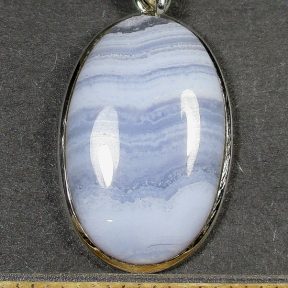
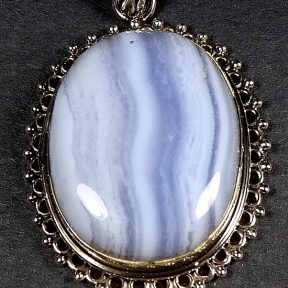
This is a very pretty sterling Silver pendant with a 17 mm
x 24 mm Blue Lace Agate stone. This pendant measures 1 5/8" from the
top of the bail to the bottom of the setting. The bail size is 3/8".
Agates mostly occur as nodules in volcanic rocks or waters containing silica
in solution possibly derived from the decomposition of silicates in the lava.
The siliceous matter is deposited in regular layers resulting in the banded
or striped formation.
|

Blue Lace Agate
|
|

|
$35.00 |
PN306b
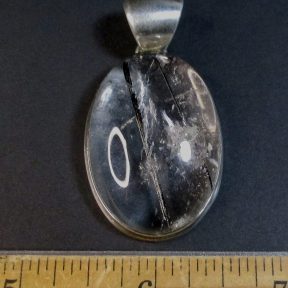
Here is a very pretty sterling Silver pendant with a 20 mm
x 30 mm Crystal Quartz stone. The pendant has tiny, scattered dots of
Brown and Red Hematite creating a very unique design and appearance.
This pendant measures 1 1/2" from the top of the bail to the bottom of the
setting. The filigree bail size is 3/8". Quartz is the second
most common mineral in the Earth's continental crust. It is mainly composed
of Silica or Silica based minerals. Although Quartz is known by a variety
of names, the most important distinction between types of Quartz is that of
macro-crystalline, individual crystals visible to the unaided eye, and micro-crystalline,
where aggregates of crystals are only visible under high magnification.
There are many forms of Quartz including Chalcedony, Amethyst, Citrine, and
Carnelian which are results of mineral impurities or heat treatments.
|

Crystal Quartz
|
|

|
$32.00 |
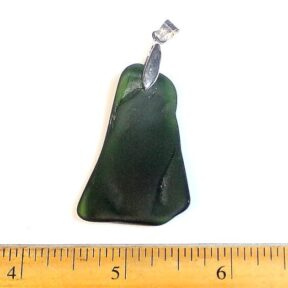
PN308c
This is a very pretty Silver, wire wrapped pendant with a 14
mm x 22 mm Moldavite stone. The pendant measures 1 1/4" from the top
of the bail to the bottom of the setting . The bail size is 1/8".
Moldavite is the product of a meteor collision with the Earth nearly
15 million years ago. It fell over what is now called the Moldau River
valley in the Czech Republic. These green gems are among the most rare
minerals on the Earth. They have been prized by humans for thousands
of years and are still given as gifts from royalty to royalty.
|

Moldavite
|
|

|
$32.00 |
PN302b
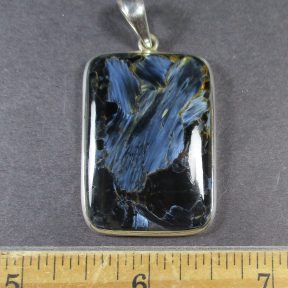
This is a pretty sterling Silver pendant with a 20 mm x 24
mm Pietersite cabochon. The stone has a nice sheen in a very nice, off-shaped
setting. This pendant measures 1 3/8" from the top of the bail to the
bottom of the setting. The bail size is 1/4".
Pietersite is a mineral very similar to Crocidolite. It has striking
combinations of gold, red and blue color segments which sometimes also include
a deep gold brown color. The mineral always has brecciated, fibrous
bands of blue, gold and/or red Tiger Eye type fibers in Quartz. Blue is the
rarest color, followed by red. All color variations have a superb, striking
chatoyancy that move along the surface of the gemstone as it is viewed from
varying angles.
|

Pietersite
|