|
Page 1
|
Cost
|
Item Description
|
 |
|
Click Picture
for Larger Image
|
|

|
$45.00 |
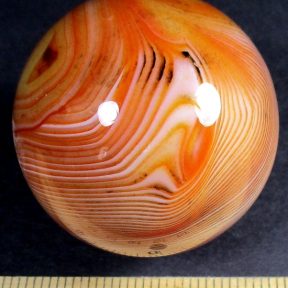
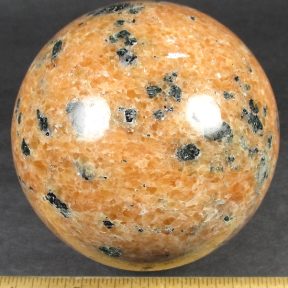
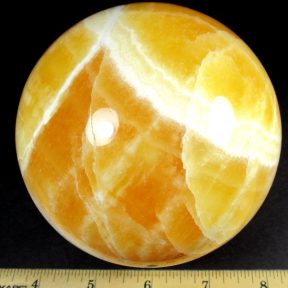
SP116c This is a pretty Orange Calcite sphere with an
interesting color mix of white and orange. It measures 3 3/4" and has a nice
polish and has a very interesting color scheme. This material is from
Mexico. A very pretty sphere.
Another
photo
Another
photo
In need of sphere stands? We have a nice selection of stands,
Click
here.
Calcite is a Carbonate mineral that is most widely distributed on the
Earth's surface. It is a common constituent of sedimentary rocks with
Limestone in particular. A Calcite formation can take on many different
shapes and sizes which is dependent on the location, ground water occurrence
and temperature. Calcite is usually white or colorless but can be gray,
red, yellow, green, blue, violet, brown or black. The deeper the color
is usually indicative of the definitive impurities from the earth or water.
|

Orange Calcite Sphere
|
|

|
$100.00 |
SP117b This is a gorgeous natural Brazilian Agate sphere that
has been heat treated . This amazing sphere measures 2 5/8" and is just fascinating!
It has wonderful banding and design with 2 crystal centers! Grab this one quick as for
sure as it won't last long!
Another
photo
Another
photo
Another
photo
Agates mostly occur as nodules in volcanic rocks or waters containing
silica in solution possibly derived from the decomposition of silicates in the
lava. The siliceous matter is deposited in regular layers resulting in
the banded or striped formation.
|

Brazilian Agate Sphere
|
|

|
$80.00 |
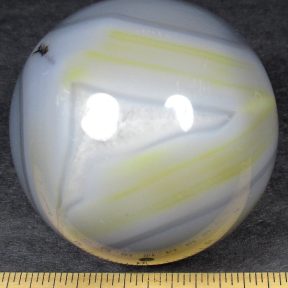
SP118b This is a gorgeous Brazilian Agate
sphere. This
beautiful sphere measures over 2 1/2" and is just lovely! It has wonderful
vibrant color, banding and design! Grab this one quick as for
sure as it won't last long!
Another
photo
Another
photo
Another
photo
Another
photo
Agates mostly occur as nodules in volcanic rocks or waters containing
silica in solution possibly derived from the decomposition of silicates in the
lava. The siliceous matter is deposited in regular layers resulting in
the banded or striped formation.
|

Brazilian Agate Sphere
|
|

|
$50.00 |
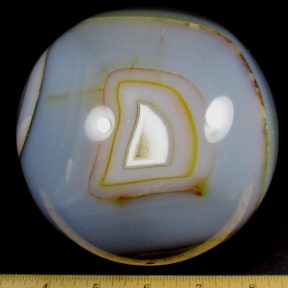
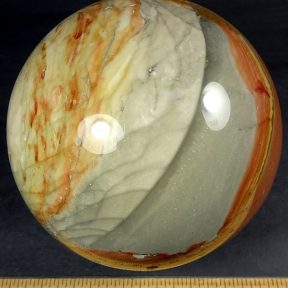
SP119c Here's a rare find, a gorgeous Brazilian Agate Geode sphere
from Brazil . This unique sphere measures over 2 1/4" and is just lovely! It
has has the best of both worlds with an Agate design on one side and an
exposed crystal cavity on the other! Grab this one quick as for
sure as it won't last long!
Another
photo
Another
photo
Agates mostly occur as nodules in volcanic rocks or waters containing
silica in solution possibly derived from the decomposition of silicates in the
lava. The siliceous matter is deposited in regular layers resulting in
the banded or striped formation.
|
Brazilian Agate Sphere
|
|

|
$45.00 |
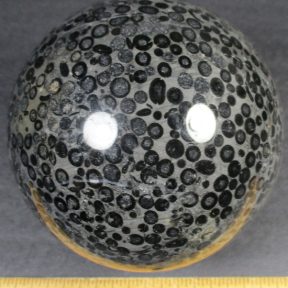
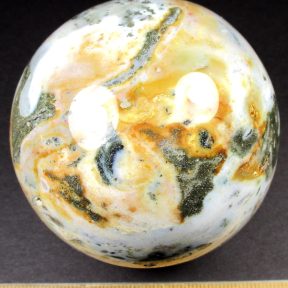
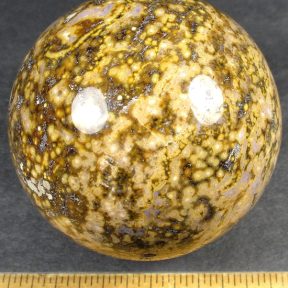
SP100b This is a very nice, multi-colored Ocean Jasper
sphere from Madagascar. It measures over
2" in diameter
and has a nice polish. This sphere has a great mix of rich color and lots
of "eyes" thrown into the mix. A very unique, super cool sphere.
Another
photo
Another
photo
This material is a new find from Madagascar. The deposit formed as a
rhyolite flow but has been completely silicified. The Rhyolitic eyes or
orbs come in an astonishing array of colors and color combinations. The
back ground can be white, pink, green, red, or yellow. Botryoidal
formations as well as white and deep green druzy are also common. This
deposit has been discovered at the edge of the ocean. It can only be seen
and collected at low tide. The area has no road so the material must be
transported to civilization by boat. This material is fast becoming a
rarity in the Jasper ocean fields, so get one while it is still available. |

Ocean Jasper Sphere
|
|

|
$140.00 |
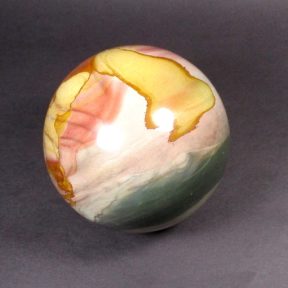
SP101b This is a beautiful sphere made from Petrified
Wood from Madagascar. It measures 3 3/4" in diameter and has
a nice polish. This sphere has a great mix of rich color and some
neat crystal areas.
Another
photo
Another
photo
Another
photo
Another
photo
Another
photo
Petrified Wood is a type of a fossil as it consists of fossil wood where
all the organic materials have been replaced with minerals while retaining
the original structure of the wood. These minerals are most often Silicates
such as Quartz. Other minerals, Manganese, Iron and Copper, in the water
or mud during the petrification process gives Petrified Wood a variety of
color ranges: black - Carbon; green/blue - Copper; red/brown/yellow - Iron.
Petrified Wood can preserve the original structure of the wood in all its
detail all the way down to the microscopic level. Structures such as
tree rings and the various tissues are often observed features. Although
Petrified Wood can be found worldwide, it is rather rare in larger quantities
and at times can be difficult to obtain by the average collector. |

Petrified Wood Sphere
|
|

|
$12.00 |
SP111c
Here is a fun start to your sphere collection. The Rock Shed
is now offering a set of six (6) 20
mm marble spheres from the marble spheres shown in the picture.
This set has a nice mix of several different gemstones including
Rose Quartz, Brecciated Jasper, Rainforest Jasper, Tiger Eye, Snowflake
Obsidian, and Dalmatian Stone.
|
Gemstone Marble Spheres
|
|

|
$60.00 |
SP126c
This is an extra quality medium sized Coral sphere with a very nice
polish. It measures 2 3/4" in diameter. This sphere has lots of Coral
sections and pieces. Very nice.
Another photo
Another photo
Coral is built by secreting calcium carbonate skeletons.
Hard coral is fossilized over millions of years. It can be almost
any color. The stony Corals are
often found in Coral reefs, large structures generally found in tropical
waters. Reefs are extremely diverse consisting of over 4,000 species
of fish, cnidarians, mollusks, crustaceans, and other animals.
|
Coral Sphere
|
 |
$110.00 |
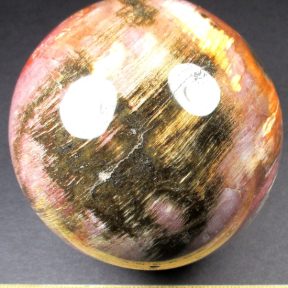
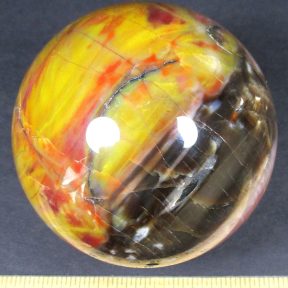
SP107c This is a new addition to the Rock Shed's sphere
department. This is an interesting, very cool Petrified Wood sphere.
It measure 3 1/2" in diameter and has a good polish. The sphere has
pretty Dark Red colors with Tan, Purple, Yellow and Brown accents as well. Very beautiful!
Another photo
Another photo
Another photo
Another photo
Petrified Wood is a type of a fossil as it consists of fossil wood where
all the organic materials have been replaced with minerals while retaining
the original structure of the wood. These minerals are most often Silicates
such as Quartz. Other minerals, Manganese, Iron and Copper, in the water
or mud during the petrification process gives Petrified Wood a variety of
color ranges: black - Carbon; green/blue - Copper; red/brown/yellow - Iron.
Petrified Wood can preserve the original structure of the wood in all its
detail all the way down to the microscopic level. Structures such as
tree rings and the various tissues are often observed features. Although
Petrified Wood can be found worldwide, it is rather rare in larger quantities
and at times can be difficult to obtain by the average collector.
|
Petrified Wood Sphere
|
|

|
$85.00 |
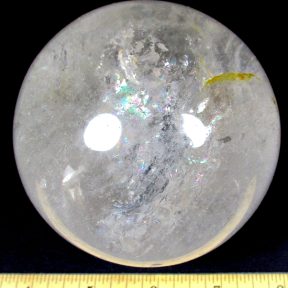
SP102c This is a very nice Clear Quartz sphere.
It is 2 5/8" in diameter and has a good polish. This lovely sphere
has sparkly inclusions even though it doesn't photograph well and would make a good addition to any collection.
Another photo
Another photo
Quartz is the second most common mineral in the Earth's continental
crust. It is mainly composed of Silica or Silica based minerals. Although
Quartz is known by a variety of names, the most important distinction
between types of Quartz is that of macro-crystalline, individual crystals
visible to the unaided eye, and micro-crystalline, where aggregates of
crystals are only visible under high magnification. There are many forms
of Quartz including Chalcedony, Amethyst, Citrine, and Carnelian which are
results of mineral impurities or heat treatments.
|
Clear Quartz Sphere
|
|

|
$45.00 |
SP108b Here is
a very nice Chrysocolla sphere. The sphere has a great mixture of
green Chrysocolla, various browns and bright blue; what we believe to be
Turquoise. This sphere measures 2" in diameter and has a nice
polish. It is a great sphere for a centerpiece or conversation piece
for any sphere collection.
Another photo
Chrysocolla is of secondary origin and forms in the oxidation zones of
copper ore. Some associated minerals are Quartz, Limonite, Azurite, and
Malachite and Chrysocolla is often confused with Turquoise as they are
similar in color. It gets it's name from Greek chrysos "gold" and kolla
"glue". It is known among Native American cultures as a healing
stone and said to promote calm and level headedness.
|
Chrysocolla Sphere
|
|

|
$75.00 |
SP109b This is an amazing sphere made from Rutilated Quartz. It measures nearly
2 1/4" in diameter and has a nice polish. This sphere has a
exceptional display of Rutiles and sparkles from all different angles.
Just fascinating!
Another
photo
Another
photo
Another
photo
Quartz is the second most common mineral in the Earth's continental
crust. It is mainly composed of Silica or Silica based minerals.
Although Quartz is known by a variety of names, the most important
distinction between types of Quartz is that of macro-crystalline,
individual crystals visible to the unaided eye, and micro-crystalline,
where aggregates of crystals are only visible under high magnification.
There are many forms of Quartz including Chalcedony, Amethyst, Citrine,
and Carnelian which are results of mineral impurities or heat treatments.
Rutile is a mineral composed primarily of Titanium Dioxide. Rutile
has among the highest refractive indices of any known mineral and also
exhibits high dispersion. Rutile is known to contain up to 10% Iron as
well as significant amounts of Niobium and Tantalum. Rutile creates small
needles within crystals that can be seen when held up to light.
|

Rutilated Quartz Sphere
|
|

|
$35.00 |
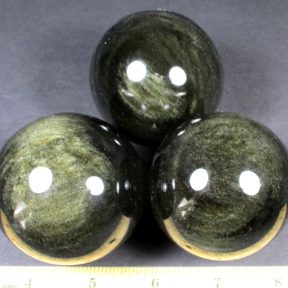
SP104c This is a beautiful Silver Sheen Obsidian
sphere. This nice sphere measures 3 1/4" in diameter and has a very prominent
Silver Sheen visible on the deep Black background on both sides. This is a
must have for any sphere collector.
Another photo
Another photo
Obsidian is a type of naturally-occurring glass formed as an extrusive
igneous rock. It is produced when felsic lava erupted from a volcano,
cools rapidly through the glass transition temperature and freezes without
sufficient time for Crystal growth. Because of the lack of Crystal structure,
Obsidian blade edges can reach almost molecular thinness, leading to its ancient
use of projectile points (arrow heads), and its modern use as surgical scalpel
blades.
|
Silver Sheen
Obsidian Sphere
|
|

|
$60.00 |
SP115c Here is
a very nice Green Tree Agate sphere. This sphere measures almost 3
1/4" in
diameter and has a nice polish. The sphere has a great mixture of
pretty green "swirls" on a white background with many very small crystal
cavities. It is a
great sphere for a centerpiece or conversation piece for any sphere
collection.
Another photo
Another photo
Another photo
Agates mostly occur as nodules in volcanic rocks or waters
containing Silica in solution which is possibly derived from the
decomposition of Silicates in the lava. The Siliceous matter is deposited
in regular layers resulting in the banded or striped formation. It is
very unlikely that you would ever find an exact duplicate of any
type of Agate, Brazilian or other. |
Green Tree Agate Sphere
|
|

|
$140.00 |
SP105c
This is a gorgeous Rhodocrosite sphere. It measures 2 3/4" and
has a nice polish. It is a lovely sphere with a nice bright and
pastel pink colors
with brighter shades in the excellent banding as well as pyrite mixed in. Beautiful!
Another photo
Another photo
Another photo
Another photo
Rhodocrosite is a Manganese Carbonate mineral. It is typically a
rose-red color, but impure specimens can be shades of pink to pale brown.
It is used as a key component of low-cost stainless steel and certain
Aluminum alloys. Quality banded specimens are often used for decorative
stones and jewelry, although it is relatively soft and difficult to cut. |
Rhodocrosite
Sphere
|
|

|
$16.00 |
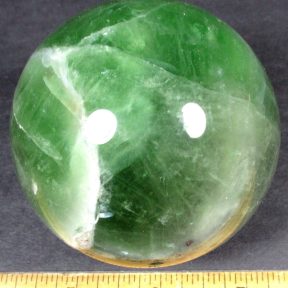
SP106b This is a pretty Fluorite sphere with a
good polish. This sphere has beautiful inclusions, good clarity and a very pretty green color
with a faint purple tint on one side. It measures over 1 3/4" in diameter. This sphere would make a great addition
to any collection! Another photo
Another photo
Fluorite, also known as fluor-spar, is a mineral composed of Calcium
Fluoride. It is a widely occurring mineral and is often found with metallic
minerals such as Galena and Sphalerite, but also with Barite, Quartz and Calcite.
It may fluoresce strongly in ultraviolet light. Although blue is the
most common color, it can also be red, purple, green, yellow and white.
|
Fluorite Sphere
|
 |
$200.00 |
SP125c
Here is a lovely Brazilian Agate sphere.
This sphere has pretty light purple tinted quartz crystal filled cavity that sparkles from every direction. It has a nice blend of
various gray colors surrounding the splendid cavity with an
interesting design. This beautiful sphere
measures nearly 3 1/2" in diameter and has a very nice polish on the
outside. Just a
magnificent sphere!
Another photo
Amethyst is a purple variety of Quartz often used as an ornament. Upon
exposure to heat, Amethyst generally becomes yellow, which some refer to
as Citrine or "burnt" Amethyst. It occurs in color from a light, slightly
pinkish violet to a deep grape purple. It is widely distributed as an
ornamental stone, but fine, clear specimens that are suitable for cutting
are used in jewelry.
|
Brazilian Agate Sphere
|
|

|
$45.00 |
SP110c This is a very nice Coral Sphere measuring 2
5/8" in diameter. This sphere has a good polish and mix of colors
in a lovely design.
Another photo
Another photo
Coral is built by secreting calcium carbonate skeletons.
Hard coral is fossilized over millions of years. It can be almost
any color. The stony Corals are
often found in Coral reefs, large structures generally found in tropical
waters. Reefs are extremely diverse consisting of over 4,000 species
of fish, cnidarians, mollusks, crustaceans, and other animals.
|
Coral Sphere
|
 |
$60.00 |
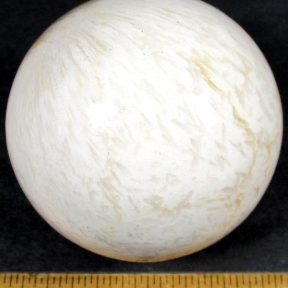
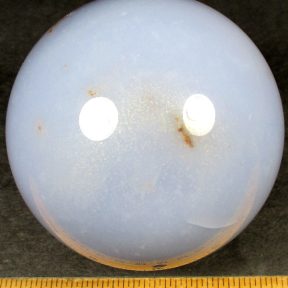
SP112c This is a beautiful sphere made from Lace Agate
from Australia. The sphere measures over 3" and has a nice polish. It has
lovely pastel colors and a unique Agate design.
Another photo
Another photo
Another photo
Agates mostly occur as nodules in volcanic rocks or waters
containing Silica in solution which is possibly derived from the
decomposition of Silicates in the lava. The Siliceous matter is deposited
in regular layers resulting in the banded or striped formation. It is
very unlikely that you would ever find an exact duplicate of any
type of Agate, Brazilian or other.
|
Australian Lace Agate Sphere
|
 |
$35.00 |
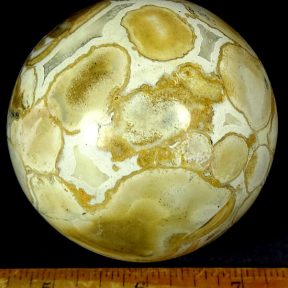
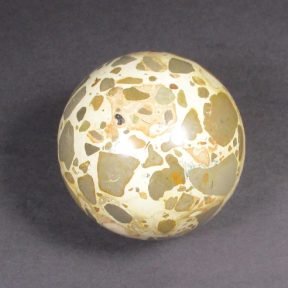
SP113b This is a medium sized, multi-colored Fossil Root
Marble sphere. It has an interesting pattern blend of
colors in a darker Earth tone color mix which resembles the "roots" from
plants. It measures nearly 3 3/4" in diameter and weighs
over 3 pounds. It does not have a high luster polish and this has been
reflected in the reduced price. A very nice and interesting sphere.
Another photo
Another photo
Marble is a metamorphic rock consisting of Limestone but composed mostly
of Calcite. It is used extensively for sculpture, building materials
and has many decorative uses. The pure white Marble is probably the
most common form known, but the characteristic swirls and veins of many colored
Marble varieties are usually due to various mineral impurities such as Clay,
Silt, Sand, Iron Oxides or Chert.
|
Fossil Root
Sphere
|
 |
$55.00 |
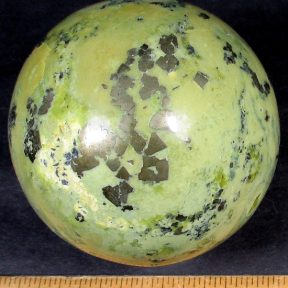
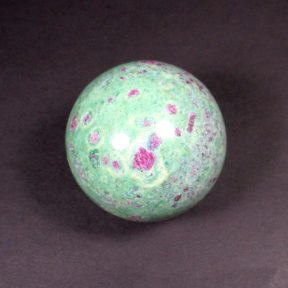
SP103b This is a good quality, gorgeous Serpentine
sphere. It measures over 2 1/2" in diameter. There is a good blend
of different shades of green as well as some hematite and pyrite speckled throughout.
Gorgeous! Serpentine is a group of common rock forming hydrous Magnesium Iron
Silicate minerals. It can contain minor amounts of Chromium, Manganese,
Cobalt or Nickel. Serpentine may refer to over 20 different varieties
that belong to the Serpentine group and the most common are Antigorite,
Chrysotile and Lizardite. The color is often green and may have a mottled
or scaly appearance.
|
Serpentine
Sphere
|